
TL;DR
Monolaurin is best taken with meals—specifically those containing dietary fats—to optimize absorption and minimize stomach upset. For consistent immune support, it should be taken in divided servings throughout the day. Avoid taking monolaurin simultaneously with prescription medications to prevent unintended absorption spikes, and never introduce high quantities abruptly.
Key Takeaways
- Taking monolaurin alongside dietary fats ensures it enters the micellar phase, optimizing intestinal absorption.
- Monolaurin can alter the pharmacokinetic absorption of certain co-administered medications, requiring staggered intake.
- Combining monolaurin with specific probiotics like Lactobacillus can safely synergize and enhance its overall efficacy.
- Introducing the supplement too rapidly can trigger a Jarisch-Herxheimer reaction, a temporary inflammatory response caused by the rapid release of cellular endotoxins.
Building a sustainable supplement routine requires prioritizing consistency over absolute perfection. However, specific contextual factors—such as meal timing, concurrent supplement use, and individual physiological tolerance—dictate how well the body utilizes glycerol monolaurate. Understanding when to take monolaurin, and just as importantly, when to avoid taking it, ensures better absorption and mitigates uncomfortable side effects.
The goal is to integrate the compound seamlessly into a daily regimen without disrupting existing metabolic or pharmacological pathways. Precise timing prevents digestive overwhelming, maintains steady systemic levels, and capitalizes on known biological synergies.
Why Should You Take Monolaurin With Food?
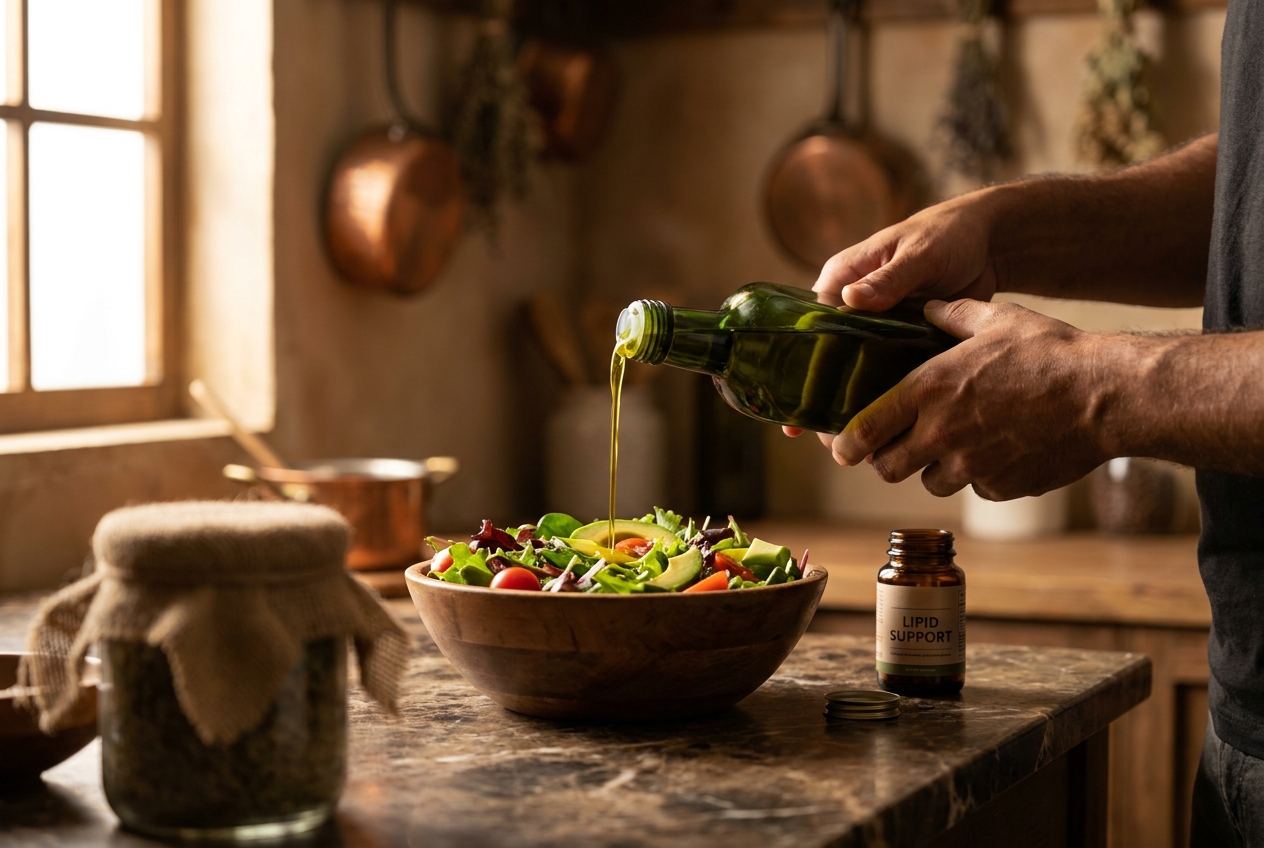
The physical environment of the gastrointestinal tract directly governs how effectively lipid-based supplements are processed. When ingested without food, monolaurin faces raw gastrointestinal exposure, which can provoke localized irritation and rapid, inefficient breakdown. Introducing the compound alongside dietary fats fundamentally alters its digestive trajectory.
Research indicates that glycerol monolaurate relies on the formation of structural lipid networks during intestinal digestion. According to a 2026 study in Food Research International, dietary fats modulate the lipolysis of monolaurin, shifting it from a rapid, volatile burst into a controlled, sustained release. This environment allows the compound to incorporate into the mixed micellar phase, a critical step required for transporting lipids across the intestinal lining. Without the presence of other fats to facilitate micellar transport, a significant portion of the supplement may pass through unabsorbed or trigger nausea.
What Factors Affect Monolaurin Absorption and Interactions?
Proper supplement timing extends beyond the presence of food. The way monolaurin interacts with other substances dictates exactly when it should be scheduled throughout the day.
Medication Interactions
The structural properties of monolaurin can unintentionally enhance the bioavailability of concurrent pharmaceuticals. A 2024 veterinary pharmacological study demonstrated that pre-treatment with alpha-1-monolaurin significantly increased the maximum plasma concentration and absorption rate of a co-administered antibiotic medication by nearly 120%. Because monolaurin alters the pharmacokinetic absorption profile of the digestive tract, taking it simultaneously with sensitive prescription drugs can cause unintended spikes in systemic medication levels. Consequently, staggering monolaurin intake away from pharmaceutical medications is a critical safety practice.
Synergistic Supplement Pairing
Conversely, specific supplements benefit from simultaneous intake. Evidence suggests that combining monolaurin with targeted probiotics enhances its biological activity safely. A 2021 study in Food & Function revealed that pairing monolaurin with Lactobacillus plantarum cell-free culture supernatant creates a dramatic synergistic effect, reducing bacterial adhesion to host cells. Taking these supplements in the same window capitalizes on this combined mechanism without introducing adverse absorption risks.
Managing Divided Servings
To maintain consistent systemic levels, staggering intake across multiple meals is structurally superior to single, high-volume ingestion. Understanding general patterns for monolaurin dosage involves splitting the daily serving into morning and evening intervals, always accompanied by food. This divided strategy prevents digestive overwhelming and sustains active compound availability throughout a 24-hour cycle. If your second serving already lands in the evening, it is a natural anchor for the rest of a wind-down routine: one melatonin-free nightly formula provides 800 mg of KSM-66® ashwagandha root extract per two-capsule serving, plus magnesium, L-theanine, and vitamin B6. Ashwagandha builds gradually, so it suits a consistent routine rather than a single night.

When Should You Avoid Taking Monolaurin?
The primary contraindication for monolaurin usage centers on the speed of introduction. Taking large quantities of the supplement without a gradual titration period can provoke acute immune distress.
This distress is clinically known as the Jarisch-Herxheimer reaction, or “die-off.” When a heavy microbial load is rapidly destroyed, the structural breakdown of these pathogens releases highly reactive endotoxins into the bloodstream. A 2020 therapeutic analysis found that a heavy monolaurin composition reduced target pathogen burdens by 75% within four weeks; this rapid clearance triggered the temporary elevation of inflammatory cytokines like IL-6 and TNF-α. Experiencing these sudden flu-like die-off symptoms indicates that the body’s detoxification pathways are overwhelmed. Users experiencing this acute endotoxin release should pause or drastically reduce intake until inflammatory markers stabilize.

Frequently Asked Questions
Can I take monolaurin on an empty stomach?
Taking monolaurin on an empty stomach often leads to rapid breakdown and gastrointestinal irritation. It requires the presence of dietary fats to properly enter the micellar phase for optimal intestinal absorption.
Should I take monolaurin in the morning or at night?
Monolaurin is best taken in divided servings throughout the day rather than at a single time. Splitting the intake between a morning and evening meal maintains consistent blood levels and minimizes the risk of digestive upset.
Can I take monolaurin with other supplements?
Monolaurin synergizes effectively with certain supplements, particularly targeted probiotic strains like Lactobacillus. However, because it alters gastrointestinal absorption rates, it should generally be staggered apart from pharmaceutical medications.
What is the Herxheimer reaction associated with monolaurin?
The Herxheimer reaction occurs when monolaurin causes the rapid breakdown of pathogens, flooding the bloodstream with cellular endotoxins. This triggers a temporary spike in inflammatory cytokines, leading to flu-like symptoms that require a reduction in supplement intake.
Summary
Optimizing a monolaurin routine requires strategic timing and contextual awareness. Taking the supplement alongside dietary fats ensures it transitions smoothly into the micellar phase, maximizing absorption while preventing gastrointestinal distress. Because of its ability to alter pharmacokinetic absorption, it must be staggered away from prescription medications, though it can safely synergize with specific probiotics. Finally, avoiding rapid, high-volume introductions is necessary to prevent endotoxin-driven Herxheimer reactions. To explore integrating this supplement responsibly, consider evaluating high-quality options at Shop Monolaurin.
Continue Exploring
References
- Zhang et al., “Composite beeswax-glycerol monolaurate oleogelation enhances encapsulation efficiency…,” Food Research International, 2026. https://doi.org/10.1016/j.foodres.2026.119323
- Kumar et al., “Pharmacokinetic enhancement of marbofloxacin by alpha-1-monolaurin pre-treatment…,” Veterinary Research Forum, 2024. https://doi.org/10.30466/vrf.2023.2007263.3988
- Kao et al., “In vitro and in vivo inhibition of Helicobacter pylori by Lactobacillus plantarum pH3A, monolaurin…,” Food & Function, 2021. https://doi.org/10.1039/d1fo01480c
- Goc et al., “Specific composition of polyphenolic compounds with fatty acids as an approach in helping to reduce spirochete burden in Lyme disease…,” Therapeutic Advances in Chronic Disease, 2020. https://doi.org/10.1177/2040622320922005